But sometimes, it is the beginning of complacency.
Because the moment a leader stops asking questions, the organization starts operating on old answers to new problems.
Meet Suresh, founder and CEO of a successful consumer business.
For almost 20 years, his experience had been his greatest advantage.
He understood the industry. He knew his customers. He could predict market cycles. He knew which products would sell and which wouldn’t.
His people often joked:
“Suresh has seen it all.”
And perhaps he had.
But the market around him was changing.
Customers were behaving differently. New competitors were entering the industry. Technology was changing how customers discovered and bought products. Younger consumers were expecting something completely different.
Yet Suresh’s response remained remarkably consistent:
“We’ve seen this before.”
His problem wasn’t lack of experience.
It was that experience had slowly become certainty.
Experience becomes a trap when you keep looking at tomorrow through yesterday’s lens.
One day, Suresh lost one of his oldest customers.
He expected the reason to be price.
It wasn’t.
He expected it to be product quality.
It wasn’t.
During the exit conversation, the customer told him something that caught him completely off guard:
“Your competitor understood where our business was going. You understood where we’d been.”
That sentence stayed with Suresh.
He had spent years understanding his customers.
But somewhere along the way, he had stopped being curious about them.
He knew what they wanted yesterday.
He had stopped asking what they might want tomorrow.
Suresh decided to change one thing.
He stopped trying to be the person with the answers.
He started becoming the person with the best questions.
In leadership meetings, he began asking:
“What are we assuming that may no longer be true?”
“What are our customers telling us that we’re not hearing?”
“What would we do differently if we started this business today?”
“What are younger people seeing that we aren’t?”
“What are our competitors doing better than us?”
“What have we changed our minds about recently?”
Something remarkable happened.
People started speaking up. Ideas began flowing. Customer conversations became deeper. The leadership team started challenging old assumptions.
And Suresh discovered something important:
He hadn’t become less experienced.
He had learned how to use his experience without becoming trapped by it.
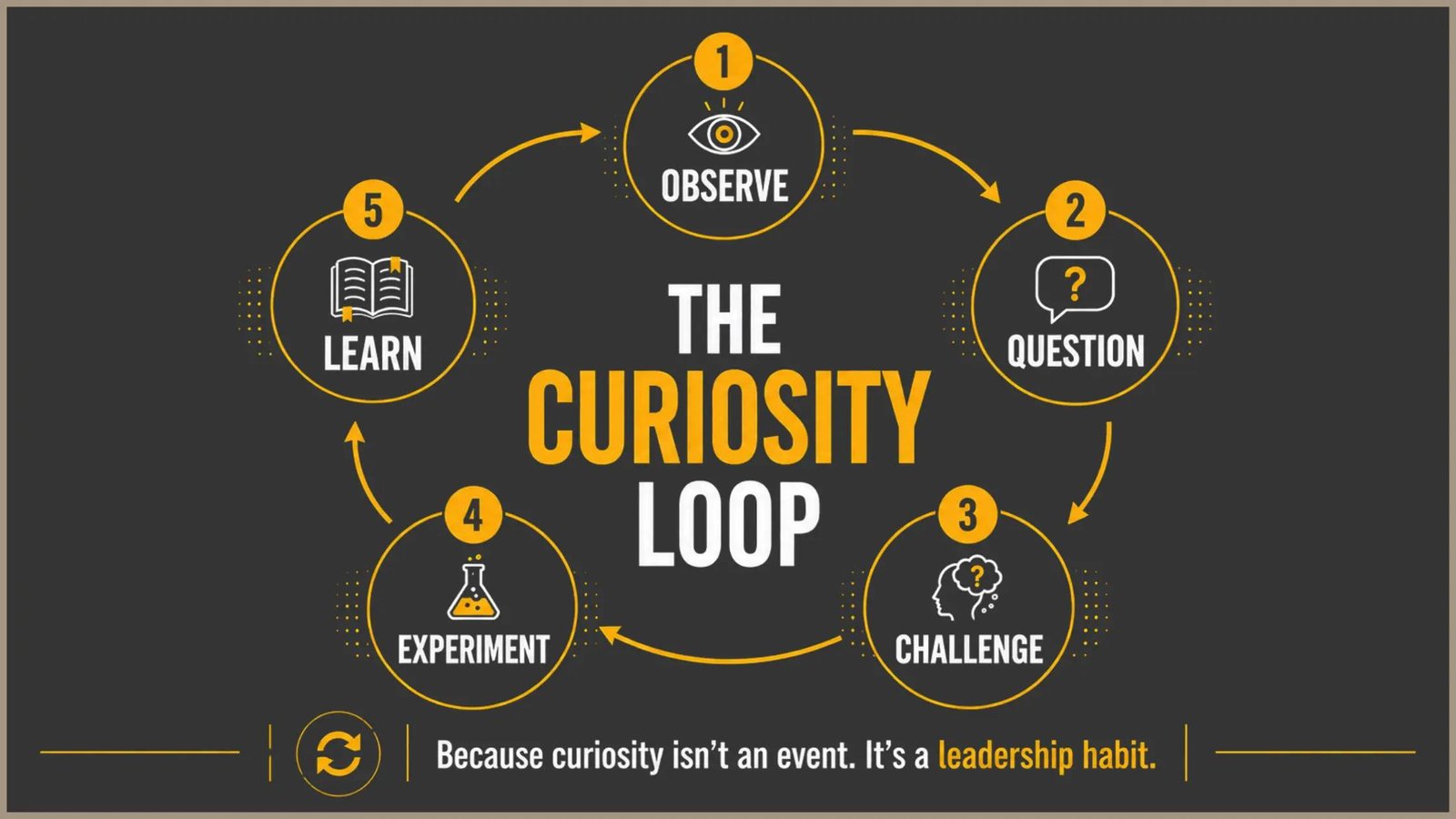
🧩 Our Solution: The Curiosity Loop
Curiosity keeps experience from becoming complacency.
The Leadership Shift
From: “I know how this works.”
To: “What am I missing?”
Coach’s Note
Experience is powerful.
But experience without curiosity can become a trap.
Because the world doesn’t stop changing just because you’ve become good at understanding it.
Experience tells you what has worked.
Curiosity helps you discover what will work next.
So perhaps one of the most important questions a CEO can ask isn’t:
“What do I know?”
It is:
“What might I be wrong about?”
Because the leader who keeps asking questions keeps the organization capable of discovering better answers.
And sometimes, the next breakthrough begins with the courage to admit that you don’t know.
Previous Newsletters:
The Biggest Obstacle in Your Business May Be Sitting in Your Chair